
Services
Raised Loft Boarding in Middlesbrough & the North East
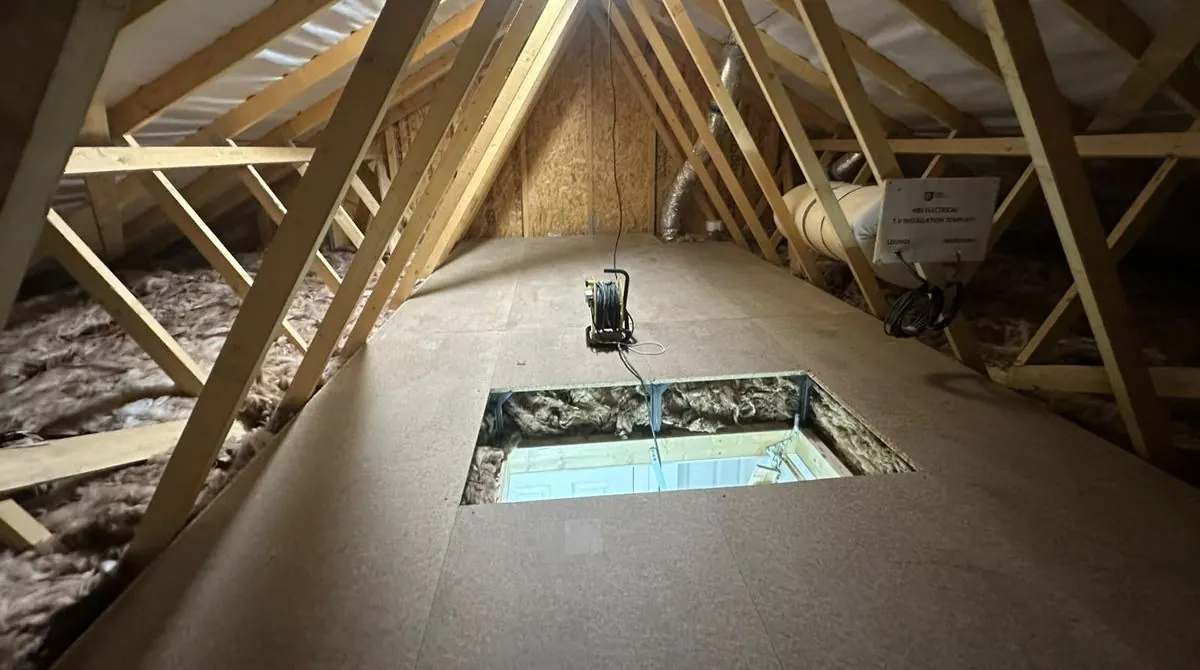
A solid storage floor on loft legs, lifted clear of the insulation so the full 270mm keeps working underneath.
- Boards raised above 270mm
- Insulation not squashed
- Eaves kept clear
- Free assessment
About this service
Raised loft boarding uses loft legs to lift the boards above the insulation. You get safe storage space without crushing the insulation that keeps the house warm.
What’s included
- Free assessment and written quotation
- Insulation checked and topped up if needed
- Loft legs sized to clear 270mm
- Tongue-and-groove loft boards fixed down
- Gap left at the eaves for airflow
- Access kept to tanks and fittings
Priced after a free assessment: see what affects the cost. You get a written quotation before any work is agreed.
Loft boarding turns a roof space you can barely stand in into somewhere useful to store things. The problem with a lot of boarding is that the boards are screwed straight onto the ceiling joists, squashing the insulation underneath. Raised loft boarding solves that: the boards sit on legs that lift them above the insulation, so you get a solid storage floor and keep the full depth of insulation working below it.
We fit raised loft boarding in homes across Middlesbrough, Teesside and the wider North East, often on the same visit as new loft insulation or a top-up, so the whole loft is sorted in one go.
Why boarding straight onto joists is a problem
Mineral wool insulates by holding still air between its fibres. The recommended depth is 270mm, but in many homes the ceiling joists are only around 100mm deep. Boarding directly on the joists over a full layer of insulation squeezes it down to the depth of the timbers. It still looks as though the insulation is there, but much of the trapped air has been pushed out and it no longer works as well.
It is common for people to top up their loft and then board straight over it, which undoes much of the benefit. Raising the boards avoids this. Our guide to boarding over loft insulation explains it in more detail.
Who raised boarding suits
- Households who need storage for suitcases, seasonal decorations, baby equipment or paperwork.
- Homes where old boards were laid directly on the joists over squashed insulation.
- Anyone having insulation installed or topped up who still wants to use the loft.
- Lofts where you have to step from joist to joist to reach a water tank or stored boxes.
Signs your loft needs boarding or re-boarding
- Boxes are sitting directly on the insulation, pressing it flat.
- You balance on the joists to move around, with the risk of a foot through the ceiling.
- Existing boards are laid straight on the joists over compressed insulation.
- Old boards are loose, cracked, damp-stained or sagging between joists.
How raised boarding works
Loft legs
Loft legs, sometimes called loft stilts, are rigid supports fixed to the tops of the joists. They lift the boarding platform above the insulation. The legs are chosen to clear the full 270mm, so the insulation underneath is not compressed, and they are fixed at regular spacings so the boards are properly supported.
Boards
Tongue-and-groove loft boards are laid across the legs and fixed down to make a firm, level platform. Boards come in sizes designed to fit through a typical loft hatch.
Insulation underneath
Before any boarding goes down, we check the insulation below. If it is thin, it is topped up to 270mm first. If it is damp, mouldy or soiled, it should be removed and replaced. Boarding over a problem makes it harder to deal with later.
Doing it properly
Keeping the eaves clear
Boards should not run tight into the eaves. Air needs to move from the eaves through the loft to carry moisture away, so we leave a gap at the edges. See loft ventilation for why this matters.
Leaving access where it is needed
Water tanks, pipe joints, junction boxes and anything else that may need attention are left accessible. Cables are routed so they are not trapped or crushed by the legs or boards.
How much of the loft to board
Most people do not need the whole loft boarded. A central area near the hatch, with a walkway to the water tank, is often enough. We look at the shape of the roof, the trusses and the headroom, and suggest a sensible area at the assessment. Loft boarding is for light domestic storage; it is not a floor for a habitable room.
Adding a loft ladder
Storage is only useful if you can get to it easily. A fitted metal loft ladder makes the loft safe and simple to reach.
Free metal loft ladder fitted with any loft boarding package over 15m², subject to survey.
Want a warmer loft space too?
Raised boarding keeps the house below warm, but the loft itself stays cold, which is how it should be with insulation on the floor. If you want to use the loft more, SuperFOIL insulation fitted to the rafters can make the space less cold. We can explain whether that suits your roof.
What affects the cost
The price depends on the area being boarded, the height of the legs needed, the shape of the loft and access, whether the insulation needs topping up or replacing first, and whether a ladder or other extras are included. You get a written quotation after a free assessment. See the loft insulation cost guide for more on what affects the price.
Who does the work
Boarding is fitted by The Insulation Company or an approved installation partner. Eligible installations come with a written guarantee of up to five years; the terms are set out in your quotation.
Areas we cover
We cover Middlesbrough and Teesside, County Durham, Tyne & Wear, Northumberland, North Yorkshire and York, and parts of West Yorkshire and the East Riding. See all the areas we cover, or call 0800 229 4668 to book a free assessment.
The process
How we handle raised loft boarding
- 1
Free assessment
We check the insulation, joists, headroom and access, and agree a sensible area to board.
- 2
Written quotation
You get the boarded area, materials and price in writing, including any insulation work needed first.
- 3
Insulation first
Thin insulation is topped up to 270mm, or spoiled insulation removed and replaced.
- 4
Boarding
Loft legs are fixed to the joists and boards laid and fixed on top, keeping the eaves clear.
- 5
Completion checks
The platform is checked for firmness, the landing is tidied and you are shown the finished loft.
Raised Loft Boarding: your questions answered
Why not just board straight onto the joists?
Joists are usually much shallower than 270mm, so boarding directly on them squashes the insulation and reduces how well it works. Raised boarding keeps the boards above it.
How much of my loft should be boarded?
Usually not all of it. An area near the hatch with a walkway to the tank is often enough. We suggest a sensible area at the assessment, based on the roof shape and headroom.
Can I use a boarded loft as a room?
No. Loft boarding is for light domestic storage. Turning a loft into a room is a conversion, which is a different job with its own regulations.
Will boarding affect ventilation?
It should not. We leave a gap at the eaves so air can still flow through the loft.
Can boarding be fitted with new insulation?
Yes, and it is a good time to do it. The insulation is brought up to 270mm first, then the legs and boards go on top. See loft insulation.
Is there an offer on loft ladders?
Free metal loft ladder fitted with any loft boarding package over 15m², subject to survey.
How much does raised loft boarding cost?
It depends on the area boarded, the height of legs needed, access and any insulation work first. You get a written quotation after the free assessment.
Free, no obligation
Ready to arrange a free loft assessment?
Tell us about your property and we will review your loft requirements, then provide a written recommendation and quotation before any work begins.